Read in



AI search has changed what it means to be visible online. Ranking on page one still matters, but search engines are increasingly answering questions directly through experiences like Google AI Overviews, AI Mode, Microsoft Copilot and other AI-powered search tools. Instead of simply deciding which pages deserve the highest positions, these systems may also decide which pieces of information are clear, trustworthy and useful enough to incorporate into an AI-generated answer.
That has led to growing interest in schema markup as an AI search optimization tactic. But there is an important distinction to make from the start: Schema markup can help search engines understand your content, but adding schema does not guarantee that your website will appear in an AI Overview or receive an AI citation.
Google specifically states that structured data is not required for its generative AI search features and that there is no special schema.org markup needed for AI Overviews or AI Mode. Traditional SEO fundamentals still apply.
So why should marketers still care about schema? Because structured data can make the meaning of a page more explicit. It can help define who created the content, what organization published it, what the page is about and how the people, products, services, organizations and other entities mentioned on your website relate to one another. In an increasingly machine-mediated search environment, that clarity matters. And clarity is essential to gain and maintain momemtum in search today.
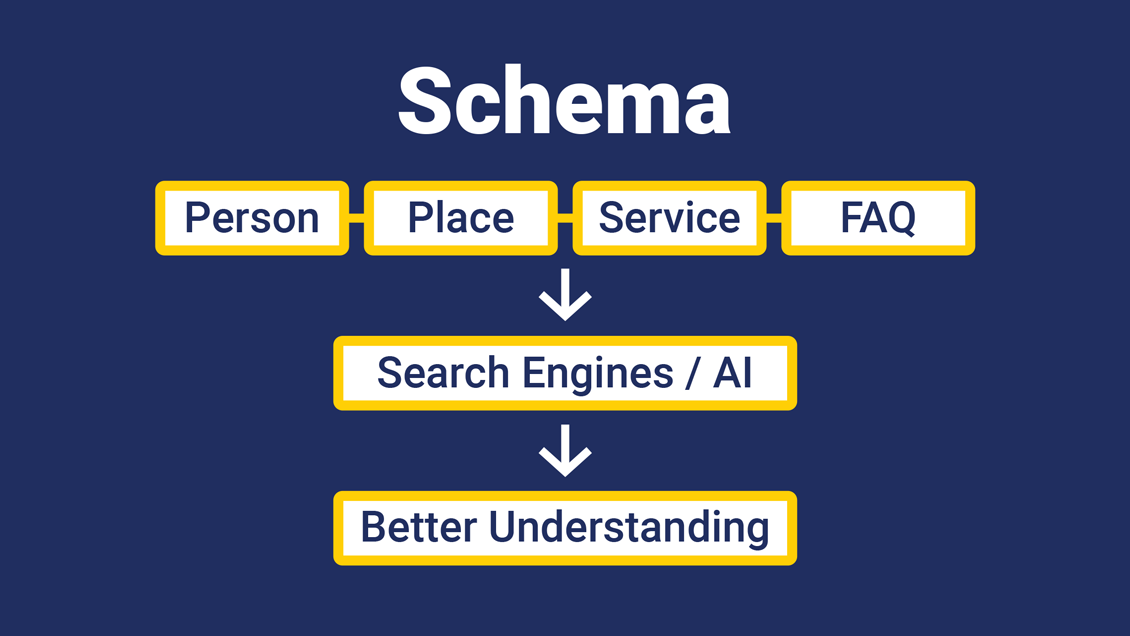
Does schema markup help with AI search?
Schema markup may help with AI search, but not in the simplistic way some claims about AI optimization suggest. Schema markup is structured data added to a webpage to explicitly describe information contained on that page. Google describes structured data as a standardized way to provide clues about a page's meaning and classify its content.
For example, without structured data, a search engine may encounter:
Jane Smith
President
Trone
High Point, NC
A person can easily infer that Jane Smith is a person who holds a leadership role at a particular organization.
With structured data, those relationships can be expressed explicitly:
- Jane Smith is a person
- Trone is an organization
- Jane Smith works for Trone
- Trone has a specific website and location
- A particular article was written by Jane Smith and published by Trone
Schema turns implied relationships into machine-readable information. That does not mean schema acts as a direct AI Overview ranking factor. Google's current guidance explicitly warns site owners against over-focusing on structured data for generative AI search. Google says there are no special technical requirements for appearing in AI Overviews or AI Mode beyond the normal requirements for Search eligibility. Still, making information easier to interpret can support the broader goal of helping search systems understand your site accurately.
What Google has confirmed
Google has confirmed that:
- Existing SEO best practices remain relevant to AI Overviews and AI Mode
- Pages must be indexed and eligible to appear with a snippet in Google Search before they can appear as supporting links in these AI experiences
- No special AI schema is required
- Structured data should accurately match the content users can see on the page
- Structured data can help Google better understand page content and make pages eligible for certain rich search features
In other words, schema remains useful SEO infrastructure, but it is not an AI citation shortcut.
What Microsoft has said
Microsoft takes a similar approach to AI search optimization. Its guidance emphasizes content that is fresh, authoritative, clearly structured and semantically understandable. Microsoft specifically recommends descriptive headings, question-and-answer formats, lists, tables and schema markup to help AI systems interpret content.
This highlights an important principle: AI visibility depends on both the information on the page and how clearly that information can be interpreted.
Schema addresses the second half of that equation.
What experiments suggest
There is also early evidence that properly implemented structured data may help. In one controlled experiment published by Search Engine Land, researchers created three similar websites with different structured data implementations:
- One had well-implemented schema
- One had poorly implemented schema
- One had no schema
Only the page with well-implemented structured data appeared in an AI Overview. It also achieved the highest traditional ranking among the test pages. The researchers were careful not to claim that the experiment proved causation. The sample was small, and other variables may have influenced the result. That distinction matters.
The evidence is interesting enough to justify taking schema seriously but not strong enough to claim that adding schema will automatically improve AI Overview visibility.
What schema can and cannot do for AI visibility
A useful way to evaluate schema is to separate established capabilities from assumptions.
Claim | What we know |
|---|---|
| Schema can help Google understand page information | Yes |
| Schema can make entities and attributes more explicit | Yes |
| Schema can make pages eligible for certain rich results | Yes |
| Special "AI schema" is required | No |
| Schema guarantees inclusion in AI Overviews | No |
| Schema automatically improves rankings | No |
| Well-implemented schema may support AI visibility | Possible but not conclusively proven |
| Schema can replace strong content and authority | No |
Schema works best as part of a larger SEO and content strategy.
How schema helps search engines understand your content
The real value of structured data becomes clearer when you think in terms of entities and relationships instead of individual schema types. An entity is a distinct thing that search engines can identify, such as:
- A person
- A company
- A product
- A location
- An event
- A service
- An article
- A topic
Schema gives machines additional information about those entities.
Entity identification
The first job of schema is helping identify what something is.
For example:
{
"@type": "Organization",
"name": "Example Company"
}
This tells a machine that Example Company should be interpreted as an organization rather than simply as words appearing on a webpage.
Entity attributes
Schema can then describe characteristics of that entity.
An organization might have:
- A name
- A logo
- A website
- A physical address
- A telephone number
- Social profiles
A product might have:
- A name
- A brand
- A price
- Availability
- Reviews
- Product identifiers
An article might have:
- An author
- A publisher
- A publication date
- A modification date
- A headline
These properties reduce ambiguity.
Entity relationships
Entity relationships are where schema becomes especially valuable. Instead of treating every page as an isolated collection of text, structured data can describe how entities relate to one another.
For example:
Organization → employs → person
Person → authors → article
Organization → publishes → article
Article → discusses → topic
Organization → offers → service
Those relationships help create a more coherent representation of your business and content across a website.
Using @id to connect entities
One useful JSON-LD technique is assigning important entities persistent @id values.
For example:
{
"@type": "Organization",
"@id": "https://www.example.com/#organization",
"name": "Example Company"
}
Another object can then reference that organization:
{
"@type": "BlogPosting",
"publisher": {
"@id": "https://www.example.com/#organization"
}
}
Rather than describing the publisher separately on every page, the markup points back to the same organizational entity. This can create cleaner and more consistent structured data across a site.
Which schema types are most useful for AI search?
There is no single "AI schema" type. The right markup depends on what the page actually contains.
Page type | Commonly relevant schema | Primary purpose |
|---|---|---|
| Company website | Organization | Identify the business |
| Author page | Person | Identify the author or expert |
| Blog article | Article or BlogPosting | Describe editorial content |
| Product page | Product and Offer | Describe products and commercial details |
| Local business page | LocalBusiness | Describe location and business information |
| Event page | Event | Describe event details |
| Website | WebSite | Describe the overall website |
| Individual page | WebPage | Describe a specific page |
The goal is not to add as many schema types as possible. The goal is to choose structured data that accurately represents what users can actually see on the page. Google's guidelines specifically stress that structured data should correspond to visible page content.
What about FAQ schema?
FAQ content can still be valuable for AI search optimization, but FAQ content and FAQ schema should not be treated as the same thing. Question-and-answer formatting is useful because it closely matches how people search and how AI systems construct responses.
Microsoft specifically recommends direct questions followed by clear answers because they create self-contained pieces of information that AI systems can interpret more easily. That does not mean every FAQ section needs FAQPage markup or that adding FAQ schema guarantees additional visibility. Use FAQ content because it helps users and covers relevant questions. Add structured data only when the markup is appropriate and complies with Google's current guidelines.
How to implement schema for AI search
A good schema strategy starts with the information architecture of the website, not a schema generator.
Step 1: Identify the primary entity on the page
Ask: What is this page primarily about?
A blog post is primarily an article. A biography is primarily about a person. A location page may primarily represent a local business. A product page is primarily about a product. Getting this classification right makes everything that follows easier.
Step 2: Choose the appropriate schema type
Choose the most specific appropriate schema type rather than trying to add every related type you can find.
A blog post could use BlogPosting.
A business website might use Organization.
A location-specific business could use an appropriate subtype of LocalBusiness.
Step 3: Add meaningful properties
Don't add properties simply because Schema.org makes them available. Focus on information that genuinely describes the entity.
For a blog article, that might include:
- headline
- author
- publisher
- datePublished
- dateModified
- image
- about
- mainEntityOfPage
For an organization, useful properties might include:
- name
- url
- logo
- address
- telephone
- sameAs
Step 4: Establish consistent entity IDs
Assign persistent @id values to recurring entities such as your company and authors. For example:
https://www.example.com/#organization
https://www.example.com/team/jane-smith/#person
Then reference those same IDs across relevant pages. Consistency is more useful than creating slightly different descriptions of the same entity everywhere.
Step 5: Connect related entities
A blog article should not exist in isolation. Connect it to:
- The author
- The publisher
- The webpage
- Relevant subjects
- The overall website when appropriate
This gives machines a clearer description of how the information fits together.
Step 6: Make sure the schema matches the visible page
Never place claims in structured data that users cannot verify on the page. If the markup says an article was written by a particular expert, the page should show that author. If the markup includes a rating, users should be able to see the rating. If the markup says a business offers a particular service, the page should support that claim.
Step 7: Validate the implementation
Use tools such as:
- Google's Rich Results Test
- Schema.org Validator
- Google Search Console
- Google's URL Inspection tool
Validation does not guarantee rankings or AI visibility, but it can identify technical errors before they interfere with how your markup is interpreted.
Example schema for an AI-optimized blog post
A stronger implementation can connect several related entities using JSON-LD and @graph.
A simplified version might look like this:
{
"@context": "https://schema.org",
"@graph": [
{
"@type": "Organization",
"@id": "https://www.example.com/#organization",
"name": "Example Company",
"url": "https://www.example.com/"
},
{
"@type": "Person",
"@id": "https://www.example.com/team/jane-smith/#person",
"name": "Jane Smith",
"worksFor": {
"@id": "https://www.example.com/#organization"
}
},
{
"@type": "WebPage",
"@id": "https://www.example.com/blog/schema-ai-search/#webpage",
"url": "https://www.example.com/blog/schema-ai-search/",
"name": "Schema Markup for AI Search"
},
{
"@type": "BlogPosting",
"@id": "https://www.example.com/blog/schema-ai-search/#article",
"headline": "Schema Markup for AI Search",
"author": {
"@id": "https://www.example.com/team/jane-smith/#person"
},
"publisher": {
"@id": "https://www.example.com/#organization"
},
"mainEntityOfPage": {
"@id": "https://www.example.com/blog/schema-ai-search/#webpage"
},
"datePublished": "2026-08-19",
"dateModified": "2026-08-19"
}
]
}
Notice what the markup is doing. It is not simply labeling the page as an article. It establishes that:
- The organization exists as one entity
- The author exists as another entity
- The author is connected to the organization
- The webpage has its own identity
- The article is associated with that webpage
- The article was written by the identified person
- The article was published by the identified organization
That kind of consistency can be more useful than adding disconnected schema objects throughout a site.
Schema alone isn't enough: Optimize the content too
Even perfect structured data cannot compensate for weak content. Google's current guidance for generative AI search continues to emphasize useful, original, people-first content and existing SEO fundamentals rather than special AI-specific optimization tactics. Microsoft similarly emphasizes content structure, semantic clarity, authority, freshness and easy extraction.
Think of the relationship this way: Content provides the information. Schema describes the information. You need both to be accurate.
Use descriptive headings
Headings should communicate what a section actually answers.
Instead of: Learn More
Use: Does Schema Markup Help With Google AI Overviews?
Specific headings help users scan the article and give search systems additional context about each section.
Put the answer immediately after the question
If the heading asks, “Does schema improve AI search visibility?” the next sentence should answer that question.
Don't make the reader work through three paragraphs of background before reaching the point. This structure also creates concise, self-contained passages that may be easier for search engines and AI systems to use.
Use lists and tables where they genuinely improve clarity
Comparison tables, numbered processes, checklists and concise lists can make complex information easier to process. Microsoft's AI search guidance specifically calls out lists and tables as useful formats for creating clear, reusable information segments. Use them where the format naturally suits the information rather than forcing every section into a list.
Make important facts self-contained
Consider the sentence: It can improve visibility. If an AI system extracts that sentence alone, "it" has no clear meaning.
Compare it with: Well-implemented schema markup may help search systems interpret page information more clearly, but schema does not guarantee AI Overview visibility.
The second sentence contains enough context to make sense outside the paragraph where it originally appeared. That is useful for people, search engines and AI systems alike.
Keep important information in HTML
Important claims, statistics, services, product details and answers should appear in crawlable text whenever possible. Avoid placing essential information only inside images, PDFs or interactive elements that are difficult to access.
Google recommends making important content available in textual form, while Microsoft similarly recommends keeping core information easily accessible in HTML.
Common schema mistakes to avoid
Poor structured data is not better than no structured data. Watch for these common problems:
- Markup that contradicts the page:Schema should reinforce what users can see. It should not introduce new claims.
- Choosing the wrong schema type: Use the type that best describes the actual page or entity.
- Adding unsupported ratings or reviews: Never manufacture review information simply to create more elaborate markup.
- Creating duplicate entities: If the same organization appears throughout the site, reference a consistent entity rather than creating unrelated versions of the organization on each page.
- Inconsistent@id values: Changing an entity's identifier from page to page defeats the purpose of establishing a persistent identity.
- Missing authorship: For editorial content, clearly identifying who created the content can improve transparency and make relationships between authors and publishers easier to understand.
- Outdated business information: Structured data should be maintained just like visible website content. If your phone number, address, leadership team, pricing or other business information changes, update the relevant structured data too.
- Adding every schema type possible: More schema is not automatically better schema. Accurate, relevant markup is more valuable than a large collection of loosely related properties.
- Assuming valid schema means better AI rankings: A technically valid implementation can still provide little strategic value. Validation tells you whether the syntax and properties meet certain technical requirements. It does not tell you that the content deserves to rank or be cited.
How to measure whether schema is helping
Schema measurement should go beyond checking for validation errors. Monitor the metrics that actually reflect search performance. Depending on your website, that may include:
- Organic impressions
- Organic rankings
- Rich-result appearances
- Click-through rate
- Search traffic
- AI Overview visibility
- AI citations
- AI referral traffic
- Branded mentions in AI platforms
- Conversion rates from search visitors
Google has historically included AI feature activity within Search Console's overall Web performance reporting, and in June 2026 it began rolling out dedicated generative AI performance reports to a subset of websites. Those reports provide additional visibility into impressions from features such as AI Overviews and AI Mode.
Where available, these reports can help marketers evaluate AI visibility more directly instead of trying to infer performance exclusively from rankings.

What actually matters for Google AI overviews?
The most important takeaway may be what doesn't change. Google says AI Overviews and AI Mode remain connected to its existing Search infrastructure and ranking systems. Pages must first be crawlable, indexable and eligible to appear in Google Search.
Google's recommendations include:
- Allow Google to crawl the page
- Make important pages easy to discover through internal links
- Create useful, reliable, people-first content
- Provide a strong page experience
- Keep important information available as text
- Use high-quality images and video when appropriate
- Keep structured data consistent with visible content
- Maintain accurate Merchant Center and Business Profile information where relevant
What Google does not require is equally important.
You do not need:
- A special AI schema type
- New AI-specific markup
- An ideal AI-focused word count
- A separate version of every article written for AI systems
- Every possible long-tail keyword variation
- Schema designed specifically for AI Overviews
In short, AI search optimization is increasingly important, but many of the fundamentals look very familiar.
Should you use schema for AI search?
When it accurately describes your content and supports your broader SEO strategy, yes you should use schema for AI search. Schema markup should not be treated as a secret trick for appearing in ChatGPT, Google AI Overviews or other generative search experiences. Its value is more fundamental.
Structured data can help create explicit connections between your content, authors, organization, products, services and other entities. It can reduce ambiguity and give search engines additional machine-readable information about what a page represents. That makes schema worthwhile even without a direct AI ranking boost.
The better strategy is to combine strong content + technical SEO + clear site architecture + structured data + real authority rather than expecting one markup script to do all the work.
Building for search engines that read before users click
AI search may feel like an entirely new SEO discipline, but schema demonstrates why the strongest strategies often build on fundamentals that have mattered for years.
Search engines still need to discover pages. They still need to interpret them. They still need to evaluate their quality. And increasingly, they need to decide whether specific pieces of information are reliable and relevant enough to use inside an AI-generated response. Schema can help clarify what your content means. It cannot make weak content authoritative, force Google to cite a page or guarantee visibility in an AI Overview.
Use it for what it does well: creating accurate, consistent, machine-readable context around the information and entities that matter most to your website.
Then support that structure with original content, sound technical SEO, strong internal linking, clear authorship and information worth citing. That combination is a much stronger AI search strategy than chasing a special markup shortcut that does not exist.
Need help using schema markup and structured data to improve visibility? Trone’s digital marketing specialists understand the complexities of SEO and AI search and how to set up the backend of your website to magnify your brand. Contact us to start the conversation.
Frequently asked questions about schema and AI search
Does schema markup help with Google AI Overviews?
Schema markup can help Google understand the information on a webpage, but Google does not require structured data for AI Overviews and does not offer special schema specifically for generative AI search. Well-implemented structured data should be viewed as part of a broader SEO strategy rather than a guarantee of AI Overview inclusion.
Does ChatGPT use schema markup?
AI systems may be able to interpret structured information on webpages, but the specific role schema plays can vary by platform, retrieval system, crawler and query. Schema should therefore be implemented because it creates clear, machine-readable information and not because it guarantees citations from a particular AI assistant.
Which schema is best for AI search?
There is no single best schema type for AI search. The appropriate schema depends on the content of the page. Organization, Person, Article, Product, LocalBusiness, Event, WebSite, and WebPage are examples of useful types when they accurately describe the entities and information users can see.
Is there a special schema type for AI content?
No. Google explicitly states that there is no special schema.org markup required for AI Overviews or AI Mode. Existing structured data should continue to be used according to normal Google Search and Schema.org guidelines.
Does schema improve Google rankings?
Google does not say that simply adding structured data will increase rankings. Schema helps Google understand page content and can make pages eligible for certain enhanced search appearances, but rankings depend on many additional factors.
Should every page have schema markup?
Not necessarily. Schema should be added when structured data meaningfully and accurately represents the content of the page. A deliberate implementation across important page types is usually more useful than automatically adding large amounts of irrelevant markup to every URL.
How do I know whether my schema is working?
Start by validating the markup using Google's Rich Results Test or Schema.org Validator. Then monitor Search Console, rankings, rich-result appearances, organic traffic, AI visibility where measurable and business outcomes. Technically valid schema is only the first step. Its value should ultimately be evaluated alongside real search performance.